The first ever mission to search for life on Mars “exomars 2016″ (ExoMars 2016) kicks off today at 12:31 Moscow time from the Baikonur Cosmodrome on the carrier rocket “Proton-M”. This is a joint Russian-European project “exomars”.
The orbiter Trace Gas Orbiter (TGO) and landing demonstration module Schiaparelli went to the fourth planet from the Sun on the planet. TGO will be used, including Russian scientific equipment developed at the Institute of Space Research.
The main objective of the mission will be to find methane in the atmosphere of the Red Planet, the discovery of which would be a confirmation of the presence of life on Mars in the present or the past, . In addition, the mission aims to “test key technologies for the second expedition ExoMars, scheduled for 2018,” said the representative of the state corporation “Roscosmos”.
According to the plan, the first stage of “Proton” separated by at 12:33 Moscow, the second – at 12:36, the third – at 12:41. After that, the upper stage “Breeze-M” with four inclusions engine displays “exomars” on the path leading to Mars. At 23:21 Moscow time it will separate from the TGO and Schiaparelli ligaments, which will continue the path on their own.

on March 15 at 00:24 Moscow” exomars “command will turn on appliances, four minutes will unfold its solar panels. At this point, the mission will be released for the first time to communicate with the Earth, its signal will Malindi station in Kenya. Another three minutes later, the European Mission Control Center will receive information about the state of the interplanetary station systems.
It is noted that the flight “exomars” to another planet will take seven months. October 16 Schiaparelli separated from TGO, to October 19 first entered the atmosphere of Mars and the other planets went into orbit. Getting Started scientific instruments unit is scheduled for mid-2017. According to the calculations of experts, the orbiter will last until the end of 2022.
Why do the researchers plan to look for is the presence of methane? More than 90% of methane in the world is produced by living organisms. At the same time methane is readily decomposed under the influence of ultraviolet radiation from the sun and can be about 300-600 years. This means that gas which is present on Mars and now can be detected by the device could not be produced 4.5 billion years ago, when the solar system planets formed. Therefore, scientists believe that it is quite natural to try to look on the Red Planet are showing signs of life.
Recently, the gas was recorded in Marsa areas adjacent to the northern hemisphere, causing the scientists of great interest, since he may well be of biological origin. This is one of the biggest mysteries of Mars, which will try to solve in the near future
“Was there ever life on Mars, albeit on a microbial level, remains one of the unsolved scientific questions of our time”. – . say representatives of the European space agency
“On Earth, the overwhelming volume of methane in the atmosphere is the result of the existence of life – said TASS Head of the laboratory of the Institute of space research Institute Daniel Rodionov -. On Mars, the situation is more complicated, methane can be a volcanic as well as biological. “
All possible theories and will be tested during the two ExoMars missions. “Through the implementation of the second stage of ExoMars mission in 2018 in Europe and Russia is the first time be possible to drill the soil of Mars two meters in depth” – said the head of the European Space Agency’s permanent mission (ESA) in Russia Rene Pischel (Rene Pishel)
The second stage of the mission “exomars” involves sending in 2018 to Mars Russian landing platform and a European rover. The key objectives of this mission will be the drilling and analysis of Martian soil. According to scientists, at a depth of several meters could be preserved traces of organic life. This stage can be postponed for 2020, if the apparatus for it will not be ready in time.
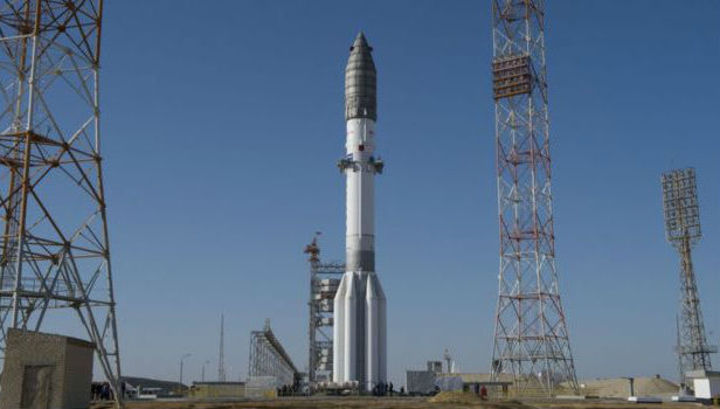
” exomars “- the first mission to Mars with Russia since the” Phobos-Grunt “. This space probe, launched in 2011, was to take soil samples from the Martian satellite Phobos, but because of the accident could not leave Earth orbit.
In 2013, Roscosmos and the European Space Agency have agreed to cooperate in the investigation the solar system, in particular on the joint project “exomars”
Updated on 13.10 March 14, 2016:. start engines of the first and second stages of the rocket went according to plan. 320 seconds – Stabilization of the launch vehicle is stable. There launching the third stage steering engine. There are off the engines of the second stage. It has been the separation of the second stage. There start the main engine of the third stage. 340 seconds – the normal flight. Pitch, yaw, rotation is normal. There discharge fairing flaps
370 seconds -. Team took off on the third stage main engine. It took off the third stage steering engine. Fixed orbital separation unit from the third stage of the carrier rocket!
The orbital unit as part of the spacecraft, ExoMars 2016 and the upper stage “Breeze-M” launched into suborbital trajectory. Further removal is carried out upper stage “Breeze-M”.
Department of spacecraft, ExoMars 2016 (the beginning of the flight to Mars) is scheduled at 23:13 MSK March 14, 2016.


No comments:
Post a Comment