Since ancient times, scientists have thought about how our horizon moon appeared. One of the largest satellites of the solar system, the researchers said, could be captured by the gravitational field of the Earth from the outside, or formed from a protoplanetary disk as well as our planet. But the basic and common hypothesis is that once a celestial body the size of Mars slammed into Earth, and causing it to split off a huge chunk of that and turned into the moon.
The theory that the moon once was part of the Earth, was formulated back in 1970 and since then has been criticized and denials. Scientists noticed that the composition of the lunar soil is similar to the chemistry of the Earth’s mantle, and therefore suggested that our natural satellite formed from the same material in a cosmic collision with a third celestial body – presumably with a hypothetical planet Thea.
Later, computer simulation showed that the majority of lunar rocks had to be entered from the surface Teyi, and not from the Earth’s mantle. Then planetary scientists decided that the composition of the Earth’s mantle and surface of a hypothetical planet destroyer should be similar. However, the calculations showed that very few objects of the early solar system conform to this criterion.
In 2007, researchers presented the main refutation of the main theories about the formation of the Moon. Planetary scientists have shown that most of the objects hit the ground today, such as meteorites and asteroids have a composition different from that observed in the Earth’s mantle and the various proportions of oxygen isotopes. Computer simulations showed that only 1% of large objects of the early solar system meet the criteria needed to confirm the basic hypothesis of the formation of the Moon.
In the new study, Alessandra Mastrobuono Battista (Alessandra Mastrobuono-Battisti) and Hagai Peretz (Hagai Perets) from the Israel Institute of Technology in Haifa, together with colleagues from the Laboratory of Astrophysics of Bordeaux in France proved that the objects which could form the moon, far more than previously thought.
Researchers have again resorted to the method of computer simulation. They decided to find out how full of small celestial bodies and the solar system planetesimals could turn into something that we see today. The simulation showed that from a thousand to two thousand protoplanets that drifted in the inner part of the solar system, could well lead to the formation of three or four rocky celestial bodies.
“In the course of our research, we discovered that the planet and body-drummer can be really very similar in composition. The simulation showed that 20% to 40% of such pairs that existed at the dawn of the solar system, could give rise to a satellite, similar to the Moon “- says lead author Dr. Mastrobuono Battista.
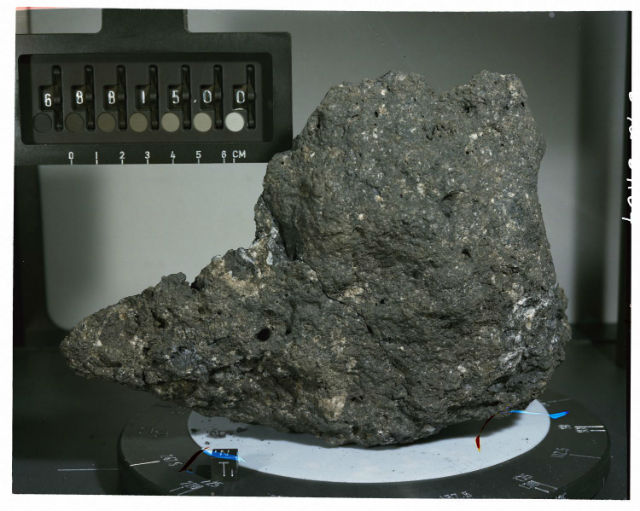
Recently, researchers have found that on the surface of the moon planetologicheskomu composition similar to quilt – so “bitty” in the composition of its crust. This puzzle scientists have yet to explain, but the primary formation history of Selene, a new study has become clearer.
The results were published an article in Nature.


No comments:
Post a Comment