- December 17, 2014
Post
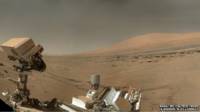
Devices rover “Kyuriositi” discovered methane emissions on the surface of Mars. The presence of methane in the atmosphere may indicate its organic origin.
Onboard spectrometers robot has long had very low background levels of methane in the Martian air, but recently they have recorded a few short peaks with a concentration of gas 10 times more background .
On Earth, methane is 95% organic origin. Scientists do not lose hope that the Martian methane may also have an organic origin.
So far, the leaders of the expedition “Kyuriositi” can not determine with certainty the source of the methane, but believe that the most likely origin of it may be due with deposits of methane hydrates, which are periodically destroyed by some unknown factors.
“This is a breed with a crystalline structure, which contain large amounts of methane. They may be destabilized by the action of mechanical or thermal loads, and then methane escapes into the atmosphere through the cracks in the rocks, “- says Dr. Sushil Altreya, which is part of a group of scientists of the project” Kyuriositi “.
Methane is, but what?
The question remains, how did these methane hydrate deposits, if they do exist.
Similar processes occur on Earth, where during the melting of the permafrost layer containing methane organic origin, methane hydrates start emits large amounts of gas.
Geologists know that another source of methane formation in rocks is serpentizatsii process in which methane is formed by the interaction of water with a number of minerals.
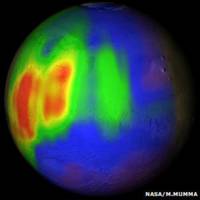
Currently, scientists can only speculate. But at least they have evidence of a salvo of methane emissions in the Martian atmosphere.
Scientists worried that in a few months the robot could not establish the existence of methane in the Martian atmosphere, despite the fact that it is found in measuring with orbiters and from Earth.
On-board laboratory “Kyuriositi” able to analyze very low concentrations of gases in the atmosphere due to the application of the method most common exceptions in the Martian air carbon dioxide molecules before starting the test.
This method allows to greatly improve the accuracy of the analysis. According to new data, background levels of methane in the Martian atmosphere is about 0.7 parts per billion by volume (ppbv).
“This parameter indicates the background that is always present in the atmosphere of about 5000 tons of methane,” – says Dr. Chris Webster, a member of NASA Jet Propulsion Laboratory, which manages this study.
“In Earth, by comparison, there are about 500 million tons of methane in the atmosphere. Its concentration is about 1800 parts per billion by volume “.
The peaks in the methane content marked robot devices, occurred four times over a period of two months.
In the course of their elevated concentrations Methane to 7-9 parts per billion.
Scientists believe that the source of this methane is somewhere nearby, either in the crater Gale, in which the rover, or immediately after his edge.
Meteolaboratory robot indicates that the methane contained in the wind that blows from the north, that is, from the edge of the crater.
The nature of the Martian methane could be resolved by analyzing its isotopic composition.
On Earth, biological processes are closely linked to the presence of the lighter isotope of carbon – carbon-12, in contrast to the heavier carbon-13.
The high excess of carbon-12 over carbon-13 in ancient terrestrial rocks traditionally interpreted as evidence of biological activity on our planet for 4 billion years ago.
If researchers can get evidence of the same or similar ratio of carbon isotopes on Mars, it will be a sensational discovery. However, so far the amount of methane to fix the device “Kyuriositi” too little for this analysis.
“If we could enrich the air sample during one of the peaks of methane, we might have been able to find it isotopic composition, – says Paul Murphy, who is responsible for the interpretation of the evidence onboard laboratory SAM.
“The hope is preserved. If we again note the high methane content and will be able to enrich the atmospheric samples, we will try to determine the ratio of carbon isotopes “.
The long journey of discovery
In the autumn meeting of the American Geophysical Union, held in San Francisco, announced another major discovery made rover “Kyuriositi”.
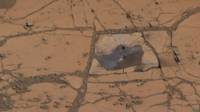
He confirmed the presence of organic molecules with a high content of carbon in the rock samples obtained during the drilling process.
This is the first reliable detection of organic molecules on the surface of the Red Planet.
SAM Laboratory has recorded the presence of molecules of chlorobenzene in the crushed rock produced during the drilling unit of sedimentary rock, the designation “Kumberlend”.
chlorobenzene molecule is a complex structure with five carbon atoms and one chlorine atom.
The presence of such molecules is not an indication of the existence of biological processes on Mars, as they could be the result of various non-biological reactions.


No comments:
Post a Comment