- 5 April 2015
Post
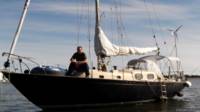
American Louis Jordan, went fishing for more than two months ago and missing on the high seas a few days later, was found alive and well in the inverted boat. Is this possible?
37-year-old Jordan, and sailed on his yacht from Conway (South Carolina) on January 23, told his family that he was going on a fishing trip. He promised to bring them big fish.
It is not known what happened next. Sailor told himself that night, during bad weather, his boat “thrown”. The mast broke in half and the beginning of the boat filled with water.
January 29 family reported that Louis was missing, but the Coast Guard could not find it. Even his father had not expected to see him alive.
But 66 days later, passing the German ship picked him up from the debris of the boat 320 miles off the coast of North Carolina.
Despite the fact that he Jordan said he feels as if he spent in the open sea for 100 days, doctors discovered he had no signs of severe dehydration, sunburn or malnutrition. He was quite healthy, especially for a man, Pete, as he claims, raw fish and rainwater.
The Coast Guard, although it does not dispute the truth of the history of Louis Jordan, says that before a complete picture of what happened is still far .
Service representative Nate Littlejohn said: “We have no reason to believe that what he told the media – it is a lie. But we can not say that he spent in the open sea 66 days. All we know – is that his family said his disappearance January 29th. We have not heard the whole story “.
66 days spent Jordan on the high seas – is much less than 13 months, which held in the Pacific Mexican Jose Salvador Alvarenga.
Haggard fisherman stranded on the Marshall Islands after 440 days. During this time he swam six thousand. Miles. He tells reporters that survived only because eating raw fish and drinking the blood of sea turtles.
Dehydration
“History has caused a lot of controversy: it is possible or it is not? ” – Says psychology professor Mike Tipton University of Portsmouth, co-author of the book “Fundamentals of survival on the high seas”.

“But if you think about it [Alvarenga] was in that part of the Pacific Ocean, where the rains are sufficient, the temperature is not so low as to be life-threatening, and he had extensive experience in fishing. So Coincidentally, the person with the right qualities, and was lucky enough to survive “- continues to Tipton.
Scientists note that the hierarchy of needs for survival is oxygen, proper blood circulation, healthy body temperature, and water only then food.
Louis Jordan says he collects rainwater and drinking in the day about a pint (568 ml). Professor Tipton says it’s a little more than necessary for survival, that is 300-500 ml of water per day.
“So much water is required to kidneys and other vital organs continue to work. Without it, you will not last a couple of days, “- says Professor.
Another available source of fluid under these conditions – it is the blood of sea turtles or birds. Of the 20-pound turtle can be learned about a liter of blood.
Stories castaways that if you can drink their urine and thereby survive implausible. According to Professor Tipton, it only leads to more dehydration.
Malnutrition
He said that people who have a substantial margin in the body fat to survive easier .
Jordan told reporters that ate pancakes and fish, which caught his own laundry. By this unusual instrument for catching fish he had to resort after catching the bait did not bring results.
However, in terms of survival in extreme conditions the fish in large quantities has one serious drawback.
“In a lot of fish protein. And for protein digestion needs more water to withdraw its by-products of digestion – explains Professor Tipton. – In this situation, the best foods containing large amounts of fat and sugar. But of course, the chocolate bar is hardly swims past “.
For drifting in the ocean is especially useful not a fish, and sea turtles. They have a lot of fat under the shell.

record holder survival
- Mexican Jose Salvador Alvarenga spent 440 days in the Pacific Ocean. He was found on the coast of the Marshall Islands, exhausted, in his underwear.
- Poon Lim, a Chinese sailor who spent 133 days in the life-raft in the Atlantic Ocean. It happened during the Second World War.
- In 2006, the Mexican Shark Hunter Jesus Vidal and his team spent 270 days drifting in the Pacific Ocean. Being picked up by the Taiwanese fishing boat near the Marshall Islands.
- American adventurer Steven Callahan spent 76 days in the life-raft in the Atlantic Ocean, after his ship rammed the whale.
Hypothermia
According to Professor Tipton, the fact that Jordan when he was found, was not sitting in the water and on the ruins of his own ship – was one of the key to his salvation. This saved him from hypothermia.
“When the body is in the water, it cools down six times faster. So you better stay away from the water,” – said the professor.
But even Despite this, an unusually cold winter in North Carolina could pose a serious threat to the life of Jordan, though it depends on how far from the coast, he drifted.
“If you map the trajectories of all the survivors in the open ocean, it turns out that they all drifted in equatorial waters. The hot tropical sun, of course, carries with it the danger of dehydration and sunstroke, but this can be combated if somehow put a shadow and collect enough rainwater, “- says Professor .
It is much harder to deal with hypothermia. If Jordan really spent 66 days in the cold coastal waters Carolina, he was supposed to be an excellent clothing or shelter from the weather.
Jim Hench, a professor of oceanography at Duke University, said that the fact that Jordan was found in 200 kilometers east of Cape Hatteras, said that he could be in the warm Gulf Stream.
“Do not forget that these waters come from the Caribbean. And this time of year the water temperature there may be up to 20 -25 degrees Celsius, “- says the scientist.
However, Jordan could not all be 66 days in the Gulf Stream, for then he would have reacted much further, says Professor Hench.
” The Gulf Stream moves at a speed slow walk – that is actually very fast for ocean waters. For 66 days on foot you can get away far enough, a distance comparable to the width of the Atlantic Ocean – counts Hench. – When I saw where he was found, the was very surprised that he had been at sea for nearly two months “.
Most likely, these two months he drifted closer to the coast, said Professor Hench.
The correct attitude
Louis Jordan says that when he saw a German ship, you will not believe his eyes.
However, he knew what to do. “I very slowly began to wave his hands, it’s a sign that I need help,” – says Jordan.
reporters, he said that these two months have been a severe test of faith: he read the Bible and pray regularly.
Jordan said that their health is much more disturbed his family and friends, because they thought he was dead.
Professor Tipton believes that this is very typical for survivors.
“Research shows how important attitude shipwrecked to what is happening. They do not give up, do not lose hope. focuses on short-term problems, for example, to survive until the evening, and then put a new task. Someone is focused on the family, the positive memories are very important for those who find themselves in an emergency situation. I noticed that when Jordan was rescued, he had a very emotional conversation with his father, “- said Professor Tipton.


No comments:
Post a Comment