- January 7, 2015
- kommentarii
Post
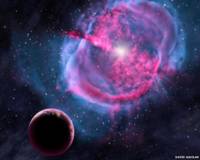
At the annual meeting of the American Astronomical Society announced a list of eight newly discovered exoplanets, one of which claims to be the “second Earth”.
List of extrasolar planets drawn up on the basis of the analysis of observations Space Telescope “Kepler”, now it has more than a thousand planets outside our solar system.
But only three of them are in the so-called “Goldilocks zone”, ie at a distance from its star, which provides roughly the same range of temperatures on the surface of the planet, as on Earth.
According to the astronomers found one of the planets, designated Kepler 438b, probably more similar to the Earth, than the previous candidate for the title of “twin” – the planet Kepler 186f.
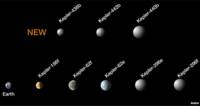
It is 12% larger than the Earth (it is slightly larger than the Kepler 186f) and orbits a red dwarf star that is at a temperature significantly lower than the temperature of the sun. In this case, the planet should get about 40% more heat than the Earth, because of the nature of its orbit.
As Dr. Doug Caldwell of the Search for Extraterrestrial Intelligence Institute in California, this planet is at a distance of 475 light years from the earth and the physical conditions on its surface can only guess.
Astronomers still do not know from what it is composed of rocks the planet – more or less accurately established only its approximate diameter and orbital parameters.
The group of researchers announced the discovery of eight new extrasolar planets, composed of 26 scientists from NASA and other US research centers.
Meanwhile, a group of scientists who analyze the results of observations from the European telescope “Kepler”, published your own list of more than 500 candidates for the title of exoplanets.
Modern astronomical technique does not allow us to obtain real images, even those closest to us exoplanets, which are fixed orbital and ground-based telescopes to small changes luminosity of the star during the passage of a planet its visible disk.
To obtain such images need a telescope interferometer with a baseline distances of tens of thousands of kilometers, which is possible only in deep space. The creation of such a telescope will be a revolution in astronomy.


No comments:
Post a Comment