the LIGO Collaboration, which includes more than 1,000 people (out of 16 countries, including Russia), the first to observe fluctuations of space-time – gravitational waves, which have come down to earth from the disaster, which occurred far in the universe. This discovery, made by September 14, 2015, reaffirms the importance of predictions of the general theory of relativity, Albert Einstein’s 1916 and opens an unprecedented new vision of the cosmos.
“The scientific value of this discovery is enormous. As in the case of electromagnetic waves, we realize it fully some time – says professor of the Physics Department of Moscow State University, Valery Mitrofanov, head of the Moscow group collaboration LIGO -. The project LIGO began in 1992, in a difficult time for our country, but Russia has joined the project thanks to Vladimir Borisovich Braginsky, one of the pioneers gravitational-wave research in the world.
I would like to point out his credit that he established a school in the Physics Department of Moscow State University, where students were able to participate actively in the LIGO project, to get the results that are important to the project, and together with a huge team of researchers to come to today’s opening. We hope that it will inspire students who are studying at the physics Department of Moscow State University, because in physics are now seen many interesting and unsolved problems “.
” The world’s first recorded flying wave curvature of space, the discovery of a new era of gravitational wave astronomy “, – commented on the events, professor of the Physics Department of Moscow State University Sergey Vjatchanin
.” this is an outstanding achievement that opens a new direction – the gravitational-wave astronomy – has required the implementation of a large project broad international collaboration of scientists, – says Igor Bilenko, professor of physics, Moscow State University fluctuations. – It is very important and it is noteworthy that the fundamental discoveries made remarkable Russian scientist Vladimir Borisovich Braginsky and his colleagues – quantum limits, methods of quantum measurement and quantum fluctuations – were needed and in demand in the project “
“A number of our research has influenced the choice of this or other decisions LIGO. The Moscow group has done a lot to combat noise and to search for a variety of effects, which in everyday life is almost never occur. They are very difficult to fix, but they have an effect on very sensitive detectors LIGO “, – the assistant Leonid Prokhorov says
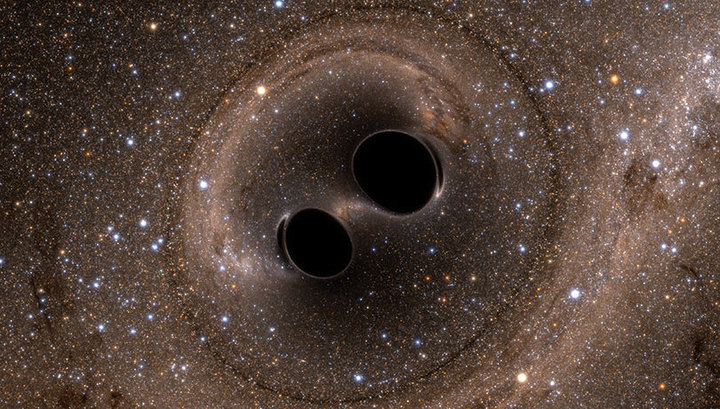
Gravitational waves carry information about the nature of the generated them of gravity and can not be explained by any other phenomenon physicists concluded.. that the detected gravitational waves are generated by the two black holes with masses of about 30 solar in the last fraction of a second they merge to form a single, more massive rotating black hole. The possibility of a collision of two black holes predicted, but such an event never before seen.
gravitational waves were recorded September 14, 2015 at 5:51 am EST summer time (13:51 Moscow time) on two detectors twin laser interferometer gravitational wave observatory (the LIGO), located in Livingston, Louisiana, and Hanford, Washington, United States.
LIGO Observatory is funded by the US National science Foundation (NSF) and was conceived, built and operated by the California and Massachusetts Institute of technology (Caltech and MIT). The discovery, reported that accepted for publication in the journal Physical Review Letters, was based on the testimony of two detectors joint scientific collaboration LIGO (which also includes the collaboration of GEO and Australian consortium Interferometric Gravitational Astronomy) and collaboration VIRGO.
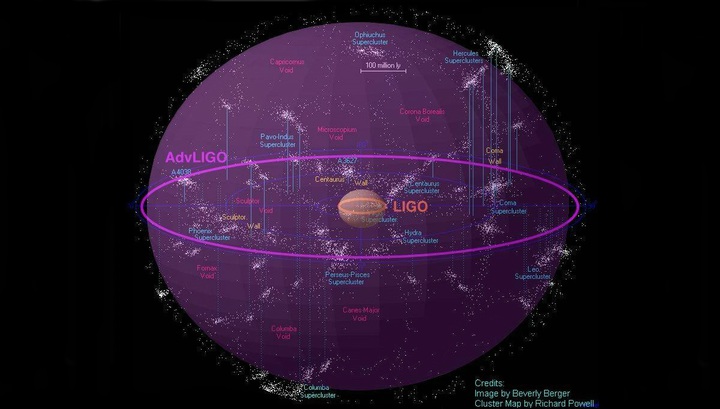
On the basis of the observed signals LIGO scientists estimate that the black holes involved in this event, had a mass of 29 and 36 times the mass of the Sun, and the event itself took place 1.3 billion years ago. For a split second about three solar masses turned into gravitational waves, the maximum radiation power which was about 50 times greater than that of the entire visible Universe
In analyzing the moments of arrival of signals -. Detector Livigstone recorded the event on 7 milliseconds before detector in Hanford – physicists can say that the source was located in the southern hemisphere
According to the general theory of relativity, a pair of black holes orbiting each other, lose energy to the emission of gravitational waves, which makes them progressively closer to. over billions of years, and much faster -. at the last minute
During the last fraction of a second two black holes collide at nearly half the light to form a single, more massive black hole. In this part of the fused mass of black holes is converted into energy according to Einstein’s formula E = mc ^ 2. This energy is emitted in the form of a strong burst of gravitational waves, which have been observed LIGO.
Gravitational waves in the world produce an extremely small change in size (a kind of compression of the globe). But LIGO detectors discovered the relative fluctuations pairs of test masses, spaced four kilometers, the size of 10 ^ -19 meters (this as many times smaller than an atom, how many atom less apple).
Let us add that the study in LIGO implemented through scientific collaboration LIGO scientific collaboration, a team of more than 1,000 scientists from universities in the United States and 15 other countries, including Russia. The development of detectors and the data analysis involved more than 90 universities and research institutes, is also making a significant contribution to the participation of about 250 students.
LSC detector network includes interferometers LIGO and GEO600 detector. GEO team includes scientists from the Institute for Gravitational Physics, the Max Planck Society (Albert Einstein Institution, AEI) and the Leibniz University in Hanover, in partnership with universities in the UK: Glasgow, Cardiff, Birmingham and others, as well as the University of the Balearic Islands in Spain
<. p> Create LIGO detection of gravitational waves was proposed in 1980 by MIT physics professor Rainer Weiss, professor of theoretical physics at Caltech and Kip Thorne, a professor of physics at the same institute Ronald Drever. Now they are all honored professors of these institutions.
VIRGO Collaboration consists of more than 250 physicists and engineers belonging to 19 different European research teams, six from the National center for scientific research of France (CNRS); eight from the National Institute of Nuclear Physics in Italy (INFN); two from the Netherlands (Nikhef); one of Hungary (Wigner RCP); Group POLGRAW from Poland and the European Gravitational Observatory (EGO), which provides the VIRGO detector work near Pisa in Italy.
The discovery was made possible by the new features of the second generation Observatory (Advanced LIGO), substantially modified compared to the first , which allowed to significantly increase the volume of the study of the universe and discover gravitational waves already during the first cycle of observation. The US National Science Foundation, a leader in the financial support of the Advanced LIGO. Funding organizations in Germany (Max Planck Society), the UK (the Council to ensure that science and technology) and Australia (Australian Research Council) has also made a significant contribution to the project.
Some of the key technologies that made the Advanced LIGO much more sensitive, have been developed and tested in Germany and the UK GEO project. Significant computing resources were provided by the cluster AEI Atlas in Hanover, LIGO laboratory Syracuse University and the University of Wisconsin-Milwaukee. Several universities have designed, created and tested the key components for the Advanced LIGO:. Australian National University, University of Adelaide, University of Florida, Stanford University, Columbia University in New York, Louisiana State University
Russia is represented by two research groups: group physics Department of Moscow state University named after MV Lomonosov Moscow state University and a group of the Institute of Applied physics (Nizhniy Novgorod)
Moscow group founded and until recently was headed by Corresponding member of the Russian Academy of Sciences Vladimir Borisovich Braginsky -. a world-renowned scientist, one of the pioneers of gravitational-wave research in the world. The composition of the research group included in the number of scientific discovery collaborators include professor of physics of oscillations: Valery Mitrofanov (the current head of the team), Igor Bilenko, Vjatchanin Sergei Mikhail Gorodetsky, Farid Khalili Strygin Sergey and Leonid Prokhorov. An invaluable contribution to the study made by students, graduate students and technical staff of the department.
The group of Moscow University involved in the project since 1992. From the outset, the main efforts were directed at improving the sensitivity of gravitational wave detectors, determination of fundamental quantum and thermodynamic sensitivity constraints for the development of new measurement methods. Theoretical and experimental studies of Russian scientists have found its embodiment in creating a new generation of detectors allowed to directly observe gravitational waves from the merger of two black holes.
In the course of the group’s work on the LIGO project produced results of fundamental importance not only for the project search for gravitational waves, but also for physics as a whole
. <-! div class="article__video-link-double"> for more information on the topic. Watch the video


No comments:
Post a Comment